

Product description

VSP 3000

Vacuum sensor

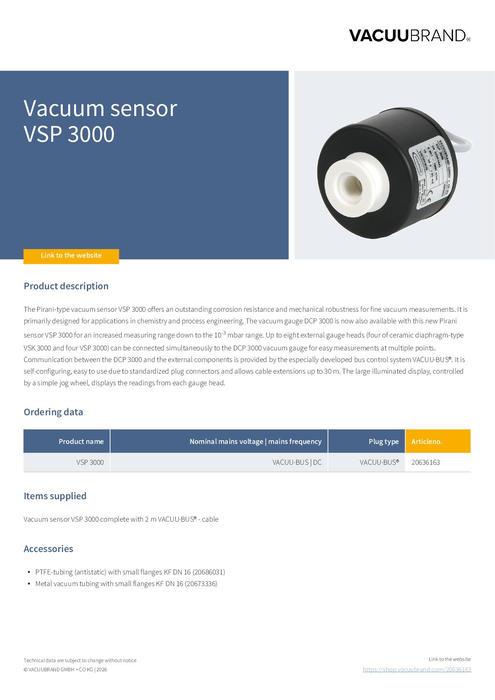
The Pirani-type vacuum sensor VSP 3000 offers an outstanding corrosion resistance and mechanical robustness for fine vacuum measurements. It is primarily designed for applications in chemistry and process engineering. The vacuum gauge DCP 3000 is now also available with this new Pirani sensor VSP 3000 for an increased measuring range down to the 10-3 mbar range. Up to eight external gauge heads (four of ceramic diaphragm-type VSK 3000 and four VSP 3000) can be connected simultaneously to the DCP 3000 vacuum gauge for easy measurements at multiple points. Communication between the DCP 3000 and the external components is provided by the especially developed bus control system VACUU·BUS®. It is self-configuring, easy to use due to standardized plug connectors and allows cable extensions up to 30 m. The large illuminated display, controlled by a simple jog wheel, displays the readings from each gauge head.

Accessories and spare parts
KF DN 16, 1000 mm PTFE-tubing (antistatic) with small flanges
20686031
KF DN 16, 1000 mm Metal vacuum tubing with small flanges
20673336
Technical Data

Technical data

Upper measuring limit in mbar/hPa 1000 mbar
Upper measuring limit in torr 750 torr
Lower measuring limit in mbar/hPa 1 x 10⁻³ mbar
Lower measuring limit in torr 1 x 10⁻³ torr
Measurement principle Thermal conductivity (Pirani), chemically resistant plastics / ceramics
Accuracy of measurement +- 15% of indicated value in the range 0.01-5 mbar/hPa/torr mbar/hPa/torr
Vacum connection Small flange KF DN 16 and hose nozzle DN 6/10 mm
Lower ambient temperature (storage) -10 °C
Upper ambient temperature (storage) 60 °C
Lower ambient temperature (operation) 10 °C
Upper ambient temperature (operation) 40 °C
Max. media temperature for continuous operation 40 °C
Max. media temperature short term 80 °C
Material of outer housing Robust plastic housing with good chemical resistance
Protection class IEC 60529 IP 54
Protection class UL50E Type 5
Weight 0.18 kg
Interface VACUU-BUS
NRTL certification Yes
Items supplied Vacuum sensor VSP 3000 complete with 2 m VACUU·BUS® - cable
Items supplied
Vacuum sensor VSP 3000 complete with 2 m VACUU·BUS® - cable
Items supplied Click to zoom
Applications

Application examples

Lyophilisation (freeze drying)
Vacuum drying oven
Vacuum drying oven
Fore vacuum for turbomolecular pumps

Lyophilisation (freeze drying)

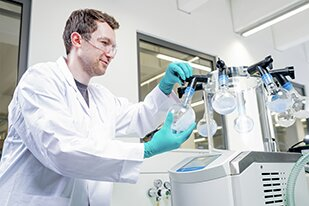
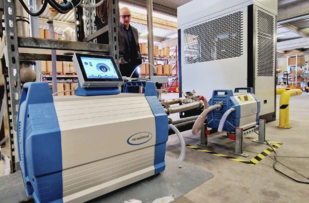
In freeze-drying, drying occurs through sublimation—the direct transition from the solid to the gaseous state. This requires pressures in the high-vacuum range, well below 1 mbar. A critical factor here is the rapid and controlled reduction of pressure during primary drying to prevent melting. For residual drying (secondary drying) and high degrees of drying, ultimate pressures in the range of 10⁻³ mbar are necessary. These requirements are met by two-stage rotary vane pumps, the Chemise-HYBRID RC 6 pump, and the VACUU·PURE 10C screw pump. The design of the pumping speed is based on the capacity of the ice condenser to optimally balance the sublimation and resublimation rates.
Lyophilisation (freeze drying)

Vacuum drying oven

For vacuum drying ovens, chemical-resistant, condensate-compatible pumps with high flow rates are essential for handling large volumes of vapor and gently drying samples. For primary drying under rough vacuum, choose oil-free chemical diaphragm pumps with a final vacuum of approximately 1–10 mbar. With VARIO control, the vacuum is adjusted via motor speed: optimized evaporation rates, reduced process times, quiet operation, and lower energy consumption. If residual drying under high vacuum is required, the VACUU·PURE 10C screw pump is ideal: oil-free, chemically resistant, with no wear parts, and featuring a regeneration mode for increased sample throughput. Recommended: AK separator (inlet) and EK exhaust condenser (outlet) for protection and near-total solvent recovery.

Vacuum drying oven

Fore vacuum for turbomolecular pumps

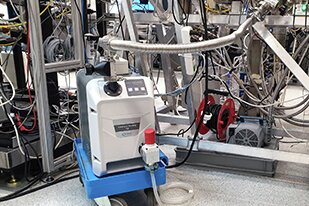
The fore-vacuum plays a decisive role in determining the ultimate vacuum (the maximum achievable vacuum) and purity in HV/UHV systems. Several factors are critical here: The fore-vacuum pump must be compatible with the maximum permissible fore-vacuum of the turbomolecular pump; its pumping speed determines both the pumping time and the maximum gas flow rate that can be handled during continuous operation. Crucial for a clean and hydrocarbon-free vacuum, especially in physics applications: Our oil-free diaphragm pumps are suitable down to approx. 1 mbar, and the oil-free screw pump VACUU·PURE down to 10⁻³ mbar. They prevent contamination and wear and tear and ensure a constant pumping speed for uninterrupted operation.

Fore vacuum for turbomolecular pumps
Downloads

Overview Downloads

image
Technical Data Sheet | PDF | 1.1 MB 1.1 MB 1.1 MB 1.1 MB 1.2 MB
image
Manual sensor | PDF | 1.9 MB 1.8 MB 2 MB